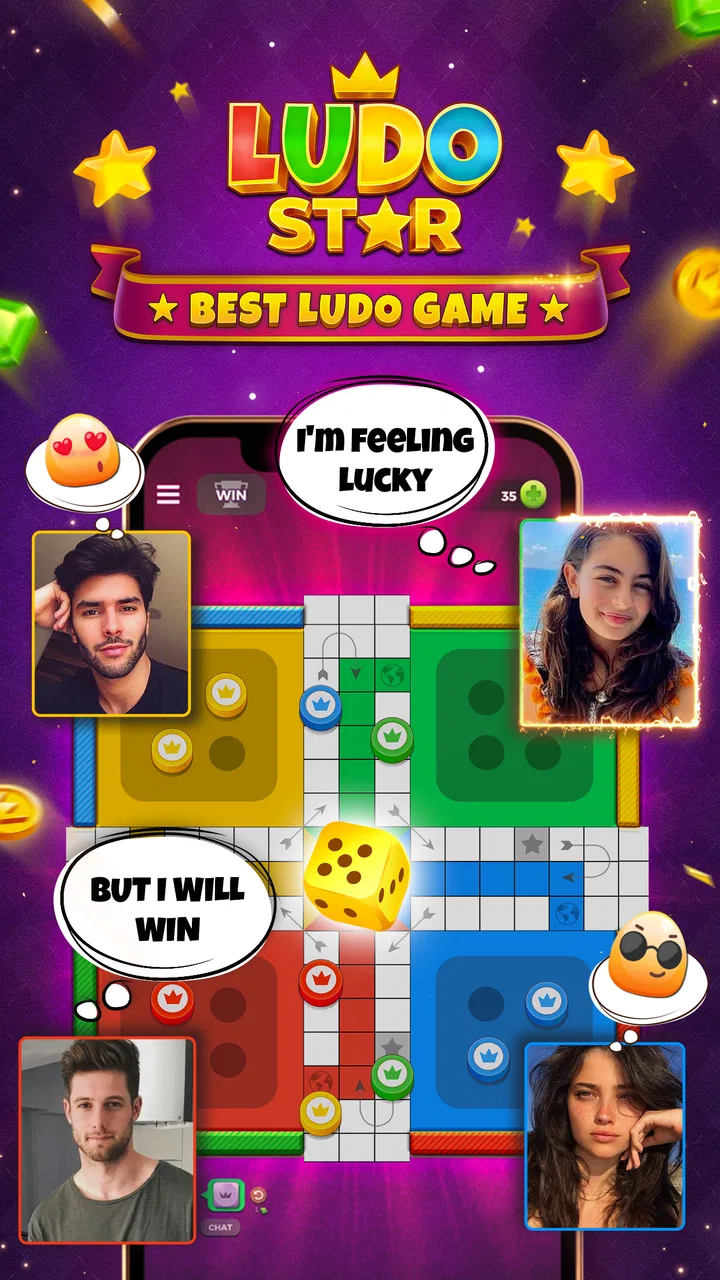
Ludo STAR: Online Dice Game
- 4.6
- Rating
- 100.00M
- Installs
- Free
- Price

 Analysis by App-foxy
I spent time with Ludo STAR as a quick, social board game rather than treating it like a serious strategy title. That distinction matters. Its appeal comes from turning a familiar dice-and-token game into something easy to start with friends, casual opponents, or people you meet through the game. It is free to download, aimed at Everyone, and made by Gameberry Labs, so the basic idea is immediately approachable even if you have not played Ludo recently.
My first impression was that it works best in short sessions. I can open it when I have a few spare minutes, make a move, chat, and leave without needing to learn a complicated rule set. At the same time, the online format adds social pressure that a physical board does not have: a slow connection, an unexpected interruption, or a match against someone with a very different playing style can change the experience quickly.
How the current version feels in everyday play
The current version is 1.331.1, and the game has clearly matured beyond being just a digital replacement for a board on the table. The central loop remains recognizable: roll, decide which token to move, protect progress when possible, and look for chances to send an opponent backward. That simplicity is the reason I can recommend it to families and casual players, but it also means people looking for deep tactical variety may reach its limits quickly.
You May Also Like

 AccuWeather: Weather Radar
AccuWeather Review: A Quick, Clear Forecast for Everyday Decisions
For everyday plans, the best forecast is the one you can understand quickly. AccuWeather makes rain timing, radar, and local conditions easy to act on, with a few trade-offs.

 Hill Climb Racing
Why Hill Climb Racing Still Turns Crashes Into One More Run
A tiny car, a bumpy hill and one more upgrade: Hill Climb Racing keeps resurfacing because its simple chaos makes every near-miss feel personal.

 AliExpress - Shopping App
AliExpress Makes Global Shopping Feel Personal, but Shoppers Bear the Risk
AliExpress turns a global marketplace into a pocket-sized discovery engine. Its reach is useful, its shopping loop compelling, and its trade-offs easy to miss.

 Lords Mobile: Kingdom Wars
Lords Mobile Is a Kingdom-Building Routine, Not a Quick Match
A case-by-case verdict on the building, battles, device demands, and social commitments that make Lords Mobile rewarding for some players and exhausting for others.

 PDF Scanner app - TapScanner
TapScanner Makes Paperwork Easier to Capture, Check, and Share
TapScanner makes scanning with a phone feel less like a rescue operation and more like a dependable step in getting work done. Its capture tools are useful, though not flawless.

 Block Blast!
 Shows How Much a Puzzle Game Can Leave Out
A quiet grid game shows why puzzle players increasingly value instant clarity, repeatable skill and low-pressure play—and where the genre still needs to catch up.
More From Our News Desk
View All News


The most useful way to approach a match is to treat every dice roll as a small decision rather than waiting for luck to do everything. I usually consider three questions before moving: can I bring another token into play, can I create a safer position, and can I threaten an opponent without exposing my own lead? This habit does not remove the randomness, but it makes the game feel more interactive than simply tapping the token that seems closest to home.
A realistic use case is a group of friends who want something lighter than a long multiplayer game. One person can play during a commute break, another can join from home, and the conversation can continue through the in-game social layer. The store summary focuses on making friends, chatting, and playing, and in my experience that social framing is important: the game is more enjoyable when the match itself is part of a conversation rather than the only reason to stay.
It is also a reasonable choice for introducing younger or less experienced players to online board gaming because the content rating is Everyone and the rules are familiar. I would still suggest that parents look at how a child uses the chat and purchase options, especially because a friendly board game can still include interactions with strangers and optional spending. The age rating makes the game broadly accessible, but it does not replace sensible supervision.
The strongest part is the decision-making between rolls
Ludo is often dismissed as pure luck, but the moments between rolls give the match its personality. If several tokens are available, choosing which one to advance can affect the entire board. Moving the obvious leader may be tempting, yet developing a second token can reduce the risk of losing all progress when an opponent catches up. I found that conservative play is sometimes better than chasing a single attack, particularly when the board is crowded.
One practical tip is to avoid thinking only about your own distance from the finish. Count the spaces that matter around your opponents as well. A token that looks safe may be sitting inside another player’s likely capture range on the next turn. Conversely, a slightly slower move can create a position that forces an opponent to choose between two awkward targets. These are small decisions, but they are where the game feels most satisfying.
Another useful habit is to keep track of which opponents have developed multiple tokens. A player with one advanced token may look dangerous, while a player with several active pieces may actually have more ways to respond. I do not need a written strategy guide to use this approach; I simply scan the board before each move and ask which future options my choice leaves open.
The trade-off is that no amount of careful play guarantees a win. Dice outcomes can undo a good position, and that can be frustrating if I am trying to play competitively. I see this as a strength for relaxed sessions and a weakness for anyone who wants a result to reflect skill more consistently. Compared with a chess app or a highly tactical board game, Ludo STAR gives luck a much larger role.
Social play changes the tone of the board
The chat and friend-focused design make matches feel less isolated than a typical offline Ludo game. When I play with people I know, the game becomes a simple shared activity: a few moves, some teasing, and a natural reason to keep a conversation going. That is where the title is more appealing than a plain local board simulator, because the opponent is not just an anonymous piece of software.
However, the same feature can be a drawback. I would not choose this game if I wanted a completely quiet, private experience with no social interruptions. Players who dislike chat, random opponents, or the possibility of uneven engagement may prefer an offline Ludo app or a local pass-and-play version. The online element is central to the identity here, not a minor extra.
There is also a difference between playing with friends and playing with strangers. With friends, a slow move can be harmless because everyone understands the context. Against unknown players, delays and unexpected behavior can make a match feel less relaxed. My advice is to use the social side intentionally: invite people you actually want to play with when you need a predictable session, and treat public matches as more variable entertainment.
The game’s large audience supports that social purpose. It has passed 50 million installs and holds a 4.7 average from around 1.5 million ratings, which suggests that the familiar format and online community have broad appeal. Those figures do not guarantee that every match will be enjoyable, but they do explain why finding an opponent or a social reason to return is easier here than in a little-known board game.
What has changed for a long-running player
Because it was released on February 26, 2017, this is not a new experiment trying to prove that Ludo belongs on a phone. It has had time to establish its identity around quick online matches and social interaction. The current version indicates ongoing maintenance and evolution, but I would separate that fact from assumptions about any particular feature change. A version number alone is not a reason to expect a completely redesigned game.
For an existing user, the important effect of that evolution is familiarity. Someone returning after a break should still recognize the board-game foundation rather than needing to relearn an entirely different product. That continuity is valuable for a casual title: I can come back after weeks away and understand the basic flow immediately. It also means the game does not need to overwhelm new players with a large learning curve.
At the same time, long-term users may notice that the core format has a natural ceiling. Updates can improve presentation, reliability, or the surrounding social experience, but they cannot change the fact that each match is built around dice, token movement, and a familiar finish line. If you have already played hundreds of sessions, the question is less “is the basic game good?” and more “does the social layer still give me a reason to return?”
I would describe the product’s evolution as refinement around a stable center rather than a replacement of that center. That is good news for people who want dependable Ludo and less useful for players waiting for a radically different board game. Newcomers get a clear entry point; veterans should judge the current experience by its variety, community, and convenience rather than expecting a new genre.
Free access, optional spending, and the practical compromise
The game is free, which makes it easy to try without committing money first. That is a major advantage for a family group or a friend who only wants occasional matches. The store lists in-app purchases ranging from $0.49 to $999.99 per item, so I would treat the purchase system as something to review carefully rather than assuming every part of the experience is cost-free.
My practical recommendation is to decide before playing whether you want this to remain a no-spend game. A free board game can become less relaxing if I start measuring progress through optional purchases or feeling pushed to buy something after a losing streak. I prefer to enjoy the matches on their own terms and keep payment decisions separate from the emotion of a close game.
This is one area where a basic offline Ludo app may suit some people better. If your priority is a simple board, local play, and no online economy to think about, a less social alternative can feel cleaner. Ludo STAR is the better fit when friends, chat, and online competition are worth more to you than absolute simplicity.
The purchase range also means I would be cautious when handing the device to a child. The Everyone rating describes the content, not a family’s preferred spending rules. Using device-level purchase protections is sensible, especially when the game is easy to open and the social environment may encourage frequent play.
Compatibility and the people who should skip it
The minimum operating system is Android 7.0, so the game is accessible on many older Android devices, although actual smoothness can still depend on the phone, connection, and other apps running in the background. I would not judge the experience solely by whether it installs. Online board games are sensitive to interruptions, and an older device with an unstable connection may make a simple match feel unnecessarily difficult.
I would skip this game if you want a purely offline pastime, dislike dice-driven outcomes, or need a board game where every result is primarily determined by planning. I would also look elsewhere if your main goal is a deep campaign, elaborate rules, or a large strategic system that changes from session to session. Ludo STAR is intentionally more immediate than those alternatives.
It is a better match for people who want a recognizable game they can explain in seconds. Families, casual groups, former Ludo players, and users who enjoy light online competition are the natural audience. It can also work as a low-effort conversation starter, provided everyone understands that the social component may be as important as winning.
One less obvious limitation is the emotional rhythm of the game. A lucky capture can feel exciting, but losing a nearly finished token can feel personal even when the dice caused it. If I am tired or already irritated, I am more likely to enjoy a short session than a long chain of matches. Knowing when to stop is part of getting the best experience from a luck-heavy game.
Small habits that make matches more enjoyable
I get better sessions when I set a simple purpose before opening the game. Sometimes I want a quick distraction, sometimes I want to catch up with a friend, and sometimes I want to test whether a safer strategy beats an aggressive one. Without that purpose, it is easy to keep starting another match simply because the previous one ended badly.
For friend groups, I recommend agreeing on the mood first. If everyone wants fast, playful competition, the game supports that well. If one person is trying to analyze every move while another is chatting casually, the same match can feel mismatched. The board is simple, but expectations still matter.
When playing strangers, I keep my attention on the board and avoid treating every opponent as a rival to defeat at any cost. That mindset helps with random outcomes and makes the chat feature less distracting. I also prefer developing more than one token when the board becomes dangerous, because a single advanced piece can create a false sense of security.
For returning players, I would spend a few matches observing before deciding whether the current version suits you. The game’s basic rules are familiar, but your preferred pace may have changed. If the social side still feels useful, the stable format is an advantage. If you now want deeper control or a calmer offline experience, its familiarity may instead feel limiting.
What I would watch before committing long term
I would pay attention to how well the online experience fits your routine: whether matches are easy to finish, whether the social interaction feels welcome, and whether optional purchases remain easy for you to ignore. These are more meaningful personal tests than the download count or rating alone. A popular game can still be the wrong choice if its pace and social atmosphere do not suit you.
I would also watch how the product continues to evolve around its established format. The current version shows that the game is still maintained, but I would judge future changes by whether they improve the everyday match without making the simple board harder to understand. For this kind of title, restraint can be as valuable as adding more layers.
After using it, my view is straightforward: this is a convenient online Ludo game with a strong social identity, not a replacement for every kind of board-game app. It is free to start, welcoming to beginners, and easy to bring into a casual conversation. Its weaknesses are equally clear: dice luck can dominate, public matches may be unpredictable, and optional spending deserves attention.
My recommendation is to try it when the goal is connection and quick play, not deep strategic control. If you want to challenge friends, chat while moving tokens, or revisit a familiar board game without arranging a physical set, Gameberry Labs has built a convincing mobile version. If you want quiet offline play or outcomes based mostly on skill, choose a simpler local alternative instead.
In the end, the game succeeds because it does not demand much preparation. I can understand a match quickly, make meaningful choices without studying a rulebook, and share the experience with another person. That combination explains its lasting appeal. Just keep the expectations realistic: the best moments come from the people and small decisions around the dice, while the least satisfying moments come from the same randomness that makes the game accessible.
FAQs for Ludo STAR: Online Dice Game
01What platforms is Ludo STAR: Online Dice Game available on?
Ludo STAR: Online Dice Game is available on both Android and iOS platforms. You can download it from the Google Play Store for Android devices and the Apple App Store for iOS devices. The game is designed to be compatible with a wide range of smartphones and tablets.
02Does Ludo STAR require an internet connection to play?
Yes, Ludo STAR requires an internet connection for most of its features. While you can play offline against the computer, most of the game’s engaging features, like multiplayer mode and online tournaments, require a stable internet connection to function properly.
03Are there any in-app purchases in Ludo STAR?
Ludo STAR offers in-app purchases that allow players to buy gems and coins, which can be used to unlock special features, customize your game pieces, or enter into exclusive tournaments. While the game is free to download, these purchases enhance the gaming experience.
04Can I play Ludo STAR with friends?
Yes, Ludo STAR allows you to play with friends by inviting them through social media platforms or directly using game IDs. This feature makes it easy to connect and enjoy a game of Ludo with your friends no matter where they are in the world.
05Is Ludo STAR suitable for children?
Ludo STAR is generally suitable for players of all ages, including children. It features a simple and intuitive interface that is easy to understand. However, parents should be aware of in-app purchases and ensure that children understand how to play responsibly without making unauthorized purchases.
Pros
- Engaging multiplayer experience.
- Smooth and intuitive interface.
- Variety of game modes available.
- Customizable game settings.
- Regular updates with new features.
Cons
- In-app purchases can be pricey.
- Occasional connectivity issues.
- Ads can be intrusive.
- Limited offline play options.
- Some features locked behind a paywall.

Ludo STAR: Online Dice Game
Gallery